
Essay: Childfree by Choice
By refusing to give birth, I have birthed the version of myself that I always wanted to be.

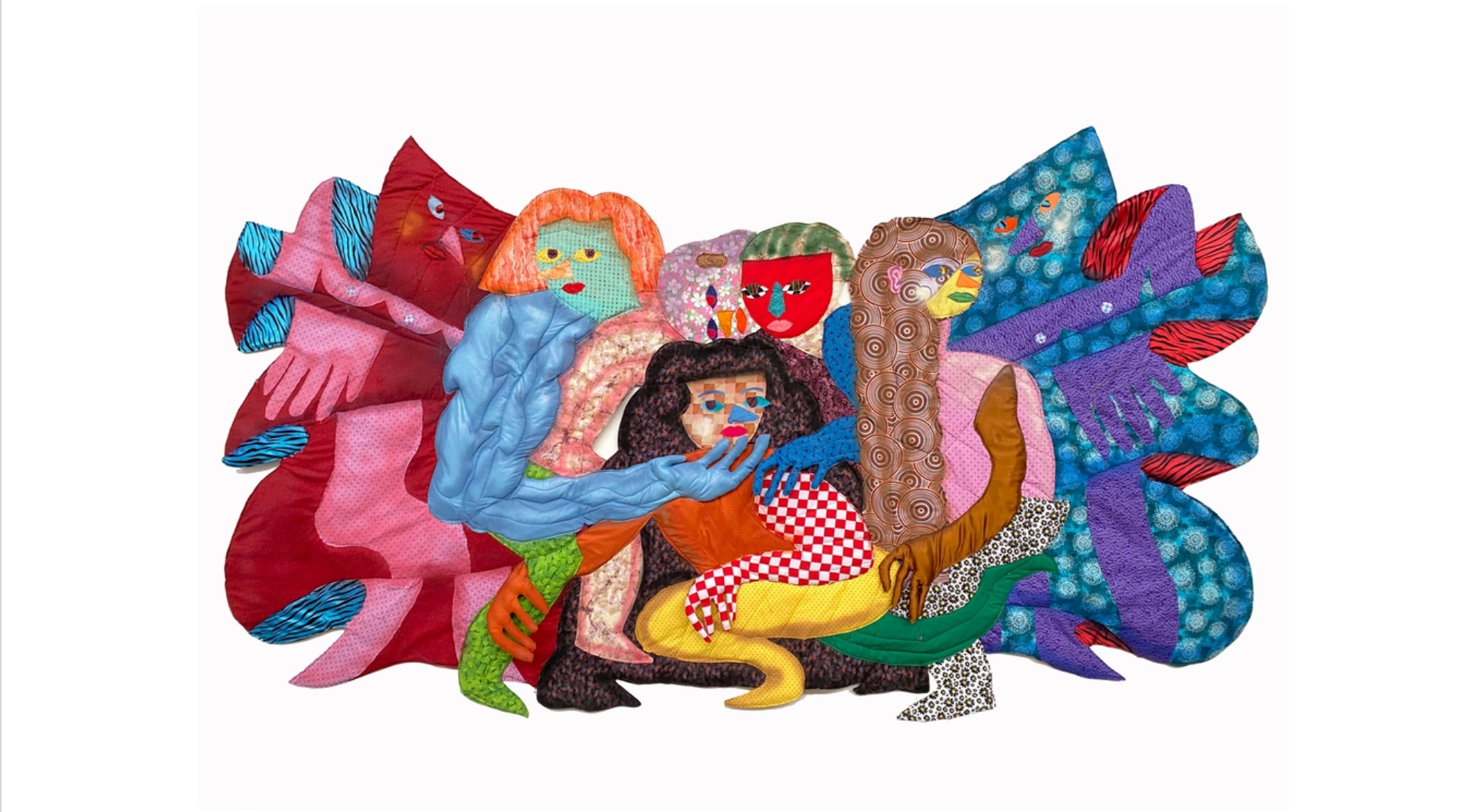
Maria Guzmán Capron, Faltas Tu. Courtesy of the artist and Nazarian / Curcio Gallery
Originally published in Guernica
I chose to be childfree so that I could live at the airport.
When one of my nephews was a toddler, his babysitter asked him where his Tante Mona lived.
“At the airport,” he replied without skipping a beat.
He would often accompany his dad, my brother, to pick me up and drop me off when I visited. It wasn’t quite a malapropism but you could make the argument that I spent more time at the airport than my actual home in New York City because without children, I was able to travel so frequently.
*
I chose to be childfree so that I could get arrested twice in as many years, without having to worry about dependents, without being told “Think of your children!”
When one of my nieces was eight, she told me she had been looking up pictures of our family online.
“I saw one of you…” she paused. “Never mind.”
I thought she’d wanted to say she’d seen a picture of me with my arms in casts after Egyptian riot police assaulted and then arrested me in Cairo, and that she worried she’d upset me with a bad memory. But in fact, she’d seen a picture of me getting arrested a year later in New York City after I spray-painted over a racist pro-Israel advertisement in the subway in 2012.
I told my niece that I was proud of getting arrested. We had a good chat about why I spray-painted over the ad and why protesting was important. And then, together, we looked at the pictures of me getting arrested. And our conversation continued:
Niece: I know why you got tattoos. (Pointing to my forearms.)
Me: Why?
Niece: Because they broke those arms and you wanted to say, “I’m free and awesome!” (Pause.) Why did they break your arms?
Me: They wanted to scare me and make me go home and stop protesting.
Niece: Did you go home?
Me: No.
Niece: Good!
*
I’m childfree by choice so that I could spend five weeks helping my sister and her husband with their firstborn—in awe and admiration at their evolution into loving parents—hold my sister’s baby to my chest and feel the euphoria of pure, unconditional love, and return home still happy that I chose not to have children.
I’m childfree by choice because I am the worst thing a woman could be: selfish.
I’m childfree by choice because I chose me.
I am childfree by choice because I wanted to be free.
At sixteen, I vowed that I would never allow myself to be held in a situation that I could not walk away from. The year before, my family had moved to Saudi Arabia. As soon as we did, I felt like I had been sentenced to a lifetime in prison because being there was so suffocating and stifling. I could not go anywhere unless my brother accompanied me. I saw my mother—who, like my father, was a medical doctor—no longer able to drive because women then were not permitted to. Back then, in 1982, before we bought a car that only my dad could drive, when we would board a public bus, women would have to sit at the back.
There, I was traumatized into feminism. There, I promised myself that I would always be free enough to be able to walk away, at any time. Without actually saying “I’m never going to have children”—without thinking about children at all—I had already vowed to myself not to have children. I had already decided that freedom—my own—would be my firstborn.
And now that I am postmenopausal, I am glad that I kept that vow to myself.
By refusing to give birth, I have birthed the version of myself that I always wanted to be.
*
When I was younger, I used to say in response to, “Do you have children?” that my books were my children.
I grew to utterly reject that notion. I want to challenge the idea that we need to live on through something, be it children or books.
As I rejected, “Oh but you would’ve made a great mother.”
As I rejected, “Happy Mother’s Day,” yelled at me by complete strangers on the street.
As I rejected, “You mother so many of us,” said to me by kind readers when I complained that random people would wish me a Happy Mother’s Day. I wanted to challenge the idea that a cisgender woman must mother someone or something.
And I reject all the above because I claim the right to be selfish. I always say the worst thing a woman can be called is not a bitch or cunt, but selfish.
Those of us assigned female at birth are expected not only to put that womb into the service of patriarchy, but to more fundamentally offer ourselves up in service. To mother is to be in service—that most “feminine” of enterprises in the form of care and caregiving. To always put others first. To never say, “I come first.” To always sacrifice. To never insist that you are worthy, empty womb notwithstanding.
My books are not my children.
I do not mother the people who read and are influenced by my work.
I would not have made a “good mother.”
I am a great aunt.
When I started saying in public lectures that I was childfree by choice, women would track me down in a corridor, backstage, or in the bathroom to whisper, “Thank you. I have never heard another woman say that out loud before.” It was an important reminder that silence is the brick and mortar of shame, and I was glad to help to dismantle that house of stigma.
I am happy with the life I have created. I have never wondered what it would have been like to have children. I say that because we often hear, “You’ll regret it when it’s too late.” Well, here I am on the other side—it is “too late”—and I am here to say: I do not regret it.
*
Most books and essays I have seen about being childfree by choice are written by cisgender white women. We need to hear from more Black women and women of colour, and women from different cultural and faith backgrounds as well as trans and gender-expansive people who choose to be childfree.
Looking back from this side of menopause to the years when I could—but refused to—have children, I recognise that something that worked to my advantage was that I was married just for two years. For a woman of my background (Egyptian, Muslim family) and generation (I was born in 1967), the pressure to have children was built into socially acceptable life scripts, such as marriage. But my parents neither pressured me to marry young (I was thirty-three when I met the man I married), nor to have children during my brief marriage. I am forever grateful. I know from my extended family that my life choices are unorthodox and rare.
Looking back now, I see that it was partially because my parents themselves were, for their generation and family, unorthodox. They both chafed under the strict hierarchical nature of their chosen careers in Egypt—and as soon as they could get a scholarship to continue to study abroad, moved us to London so that they could get PhDs in medicine. My mother is one of eleven siblings and my father is one of eight, and yet there we were in our small unit of four, living on meager student stipends thousands of miles away from all that they knew. I marvel at their daring sometimes—to move a young family to a new country and to complete dissertations in a new language!
Their wonderful adventure released me to embark on my own adventure. Even though I am the eldest—and the eldest daughter to boot—they have watched me turn my back against one social expectation after another. There have been some fights but I know, because they tell me, that they are proud of me.
I am forever grateful.
I know—from friends in my social circle of Muslim women and women from North Africa and South West Asia—that a growing number of women are having or trying to have children outside the “acceptable” configuration, i.e. marriage to a man. They include: women who are not married, women who are lesbian or bisexual, women who marry a friend or agree to co-parent with a friend so that they can have a child, and women having a child through surrogacy.
Such arrangements are still taboo—to the extent that in 2017, an Egyptian TV presenter was sentenced to three years in jail for daring to talk about ways to become pregnant outside of conventional marriage on her show.
What would the freedom to choose, for all, look like?
*
I should never have been childfree because my extended family is so fecund and full of progeny. My paternal grandmother had eight children. My maternal grandmother had eleven children (she was pregnant fourteen times). My mother is the eldest of those children and she has three children of her own. I am the eldest of those children—and I am glad to have none of my own.
How does my family tree look, my branch abruptly ending with me? I wonder if I am my ancestors’ wildest dream or wildest nightmare. I am fifty-eight, divorced, queer, nonmonogamous, and childfree by choice. I am determined to become the wild ancestor for future generations—the ancestor that I have always wanted to have. Can you be an ancestor if you are childfree by choice? Can you celebrate your descendants, when you yourself are childfree?
I am being poetic. But also deliberately heterodox when it comes to lineage and the ways patriarchy lays claim to it.
I am Mona, daughter of Ragaa, daughter of Na’ima, daughter of Amina. I am working on a family tree that is richer and more expansive than tracing men to the original patriarch.
Let’s also create family trees that are richer than their number of progeny; to see the branches that end abruptly with ourselves as not “less,” as in childless, but “more,” as in blossoming with love, rebellion, and freedom. There’s more than one way to grow.
When I was eleven years old, I had a teacher who would tell us that people are either birds or trees—those who are forever flighty, or those who value deep roots. I always thought I was the former, but now that I am working on that new kind of family tree, I think of the airport as the place from which I fly to the various branches of my family. I am both bird and tree. Perhaps I am more accurately a bumblebee, cross-pollinating those various branches.
I hope that as they grow up, my niblings—a gender-neutral word to describe the children of siblings—remember that Tante Mona is happy to live at the airport, to get arrested, to cherish the ways they have expanded my heart’s capacity for euphoria—and to be childfree by choice.
Mona Eltahawy
Mona Eltahawy is an award-winning feminist author, commentator and disruptor of patriarchy. Her latest book is an anthology on menopause that she has edited called Bloody Hell! And Other Stories: Adventures in Menopause from Around the World. Her first book Headscarves and Hymens: Why the Middle East Needs a Sexual Revolution (2015) targeted patriarchy in Southwest Asia and North Africa and her second The Seven Necessary Sins For Women and Girls (2019) took her disruption worldwide. She is working on a memoir to be called The King Herself: How Hatshepsut Helped me Unbecome. Her commentary has appeared in media around the world and she writes the newsletter FEMINIST GIANT.
Maria A. Guzmán Capron
Maria A. Guzmán Capron creates exuberant fabric-based sculptures that embody hybridity and multiplicity. Born and raised in Milan to Colombian and Peruvian parents, Maria moved to Colombia and then Texas as a teenager. She weaves together textiles–found in markets or hand-dyed, hand-painted and silkscreened, then sewn, stuffed, and quilted–to form figures in a mélange of faces and limbs with ambiguous boundaries. Drawing from her identities as immigrant, mother, and non-binary, and subverting the social hierarchies that can be signaled by certain fabrics, Capron celebrates connection and vulnerability and crafts spaces in which difference can thrive. Maria received her MFA from California College of the Arts and her BFA from the University of Houston. Her work has been exhibited at the San Francisco Museum of Modern Art, Blaffer Art Museum, and Shulamit Nazarian, among others, and is held in the collections of the de Young Museum and the Speed Art Museum.