

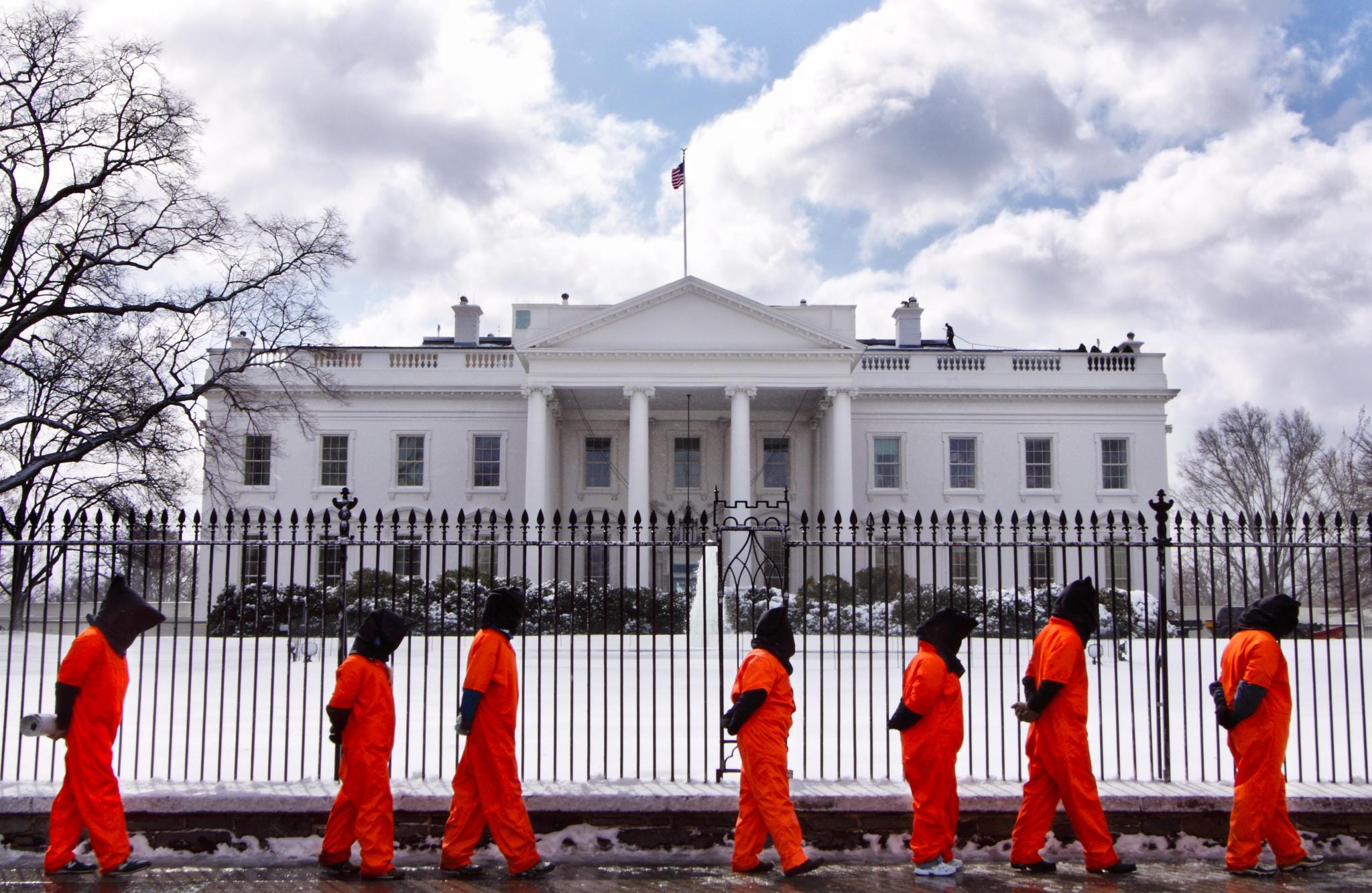
Protesters outside the White House. Photo: Greg Foster
First published on April 05, 2025
I first visited the White House in 2005. George W. Bush was president and I received an invitation that year from the office of then Secretary of State Condoleeza Rice to the White House Iftar, but that was not why I stood just outside the gates of the home of the U.S. president. I turned down that invitation.
I was instead there as a tourist. And there sitting just outside the gates was a man in an orange jumpsuit, his hands tied behind his back, with a hood covering his head and a sign in front of him saying “Stop torture.” It was his protest against the extraordinary renditions by the United States of Muslim men from Afghanistan to countries where they would be tortured either by local security forces or CIA agents. Already, the news of waterboardings and other types of torture were defining the Bush administration’s “War on Terror.”
I wanted to chat with the man and thank him for his protest, but before I could, I saw what appeared to be a school trip of white children and white adults approach the White House gates and a girl among them, of about 10 years of age, walked up to the man in the orange jumpsuit, read his sign, and asked him “Do you hate President Bush?”
The man shook his hooded head and replied “I don’t hate President Bush. I hate what he does.”
One of the adults with the group of children, a man who appeared to be in his forties, whisked the girl away from the one-man protest.
“Thank you for protesting torture,” I told the man in the orange jumpsuit. “I’m from Egypt where torture is systemic and I really appreciate what you’re doing. It’s especially important because the U.S. props up our dictator, knowing that he tortures and violates human rights all the time.”
“Go and tell him that!” the man in the jumpsuit replied, meaning the man who whisked the girl away.
And because I like trouble, I went looking for the man.
What a luxury to think that your government will always work for your benefit. What an utter delusion to so naively trust the powerful.
“I want you to know that I really appreciate what that protestor is doing. I am from Egypt, where the regime routinely tortures people and his protest is important.”
“Well, then maybe you should go and protest that in Egypt,” he replied.
“We do,” I said.
“What do you want? A basket of fruit as a thank you?” was his comeback. What he meant to say was “I am looking at this man and I refuse to see–I refuse to see the abuses of my government; I refuse to see that abuses committed far away make their way home; I refuse to not only see but I refuse to allow this child in my care to see because I am white and we are white and we are safe from those abuses.”
“I want your government to stop propping up my government, then maybe we’d stand a chance,” I said. What I meant was “That man in the jumpsuit might be in a hood but he sees more clearly than you and he insists on forcing upon other white people like you a truth you prefer to turn away from.”
As an Egyptian, I was familiar with the difference between looking and seeing.
That adult who whisked the girl away is a perfect stand-in for many white people in the U.S.: privileged enough to be insulated from state abuse, equal parts naive and arrogant in thinking that such excesses would never come for them, and ignorant–quite often willfully–of the ways their government knows of, props up, and encourages abuse by allies around the world.
It's easy to see the fascists when they don't look like you. It’s comforting to think that if you behave, obey, keep your head down, and look like the fascist head of the regime dismantling your country, that you will be safe.
And now their government is turning into a regime before their eyes but will they see?
To look and to see are different skills. Even among white people in the U.S. who do follow the excesses abroad that their government knows of, props up, and often encourages, there is still a detachment that allows them to believe that such horrors happen to Black and brown people somewhere far away, to people who somehow deserve or have brought upon themselves whatever tyrant inflicts those abuses on them.
But those same white people in the U.S. rarely see themselves in those Black and brown people. Or imagine that such a fate can easily be visited upon them.
What a luxury to think that your government will always work for your benefit. What an utter delusion to so naively trust the powerful.
The idea that a right could be revoked is utterly alien to so many, white people in the U.S., whose very whiteness is rooted in “manifest destiny'', the 19th century doctrine and belief that the United States was destined by God “to expand its dominion and spread democracy and capitalism across the entire North American continent.” Their whiteness is about more–land, wealth, rights–not less, that that ‘more’, like all their enumerated rights, is ordained to them, by no less than God, irrevocable and clear as the plains which stretched before them.
The philosophy drove 19th-century U.S. settler colonialism and was used to justify the forced removal of Native Americans and other groups from their homes, as well “intensified the issue of slavery as new states were added to the Union, leading to the outbreak of the Civil War.”
Needless to say, “manifest destiny” is manifestly unjust. And it keeps the heart of white nationalism beating.
The same arrogance and naiveté that made so many white people in the U.S. think Trump would never become president first or second time around is that same arrogance and naiveté that made so many think "it would never happen here" about fascism, and that turn from government to regime.
The privilege of whiteness meant that for many in the U.S., there was something wrong with you if you were losing rights.
It's easy to see the fascists when they don't look like you. It’s comforting to think that if you behave, obey, keep your head down, and look like the fascist head of the regime dismantling your country, that you will be safe.
How many students, Green Card and visa holders, and migrants will it take for white people in the U.S. to understand that nothing protects you from the regime–not your obedience, not your whiteness?
I got an early lesson in the difference between looking and seeing when I became a journalist in Egypt.
My first reporting job was for a privately-owned English-language newspaper in Egypt in 1989, writing about human rights and women’s issues. One of my assignments took me to the launch of that year’s annual report from the Egyptian Organization for Human Rights, an outfit of courageous activists who exposed torture under the Hosni Mubarak regime and advocated for victims of his police state. There, I met a woman in her sixties whose story has stayed with me ever since. It showed me that revolutions are long in the making, their roots embrace many people and causes.
The woman had come to Cairo from her home in southern Egypt because her neighbours had told her that there was a group in the capital who could help her find justice. She went to the Egyptian Organization for Human Rights and told them that she ran a kiosk that sold soda and cigarettes. One day, police insisted she testify against a “car thief.” She refused, saying she didn’t know of any “car thief.” They were clearly trying to frame someone and she was having none of it and refused to bear false testimony against the man they had in custody. She told the organization that the police then dragged her to the precinct, where they sodomized her with the leg of a chair.
Such random acts of police brutality in Egypt were not unusual.
I took home with me the annual report in which her story was included. The uncle whose home I was living in–a physician, an educated man who followed the news –asked to read it. He returned it to me the next morning, shaking his head. “This happens in Egypt?” was all he could say.
Many Egyptians assumed that if they kept their backs to the wall and weren’t overtly political they could survive. To hear a story like this woman’s reminds us of the countless others who did not survive and who never got to tell their story–such as the thirteen-year-old arrested for selling tea bags who was allegedly so brutally tortured by the police that the coroner conducting the autopsy sobbed as he documented the boy’s wounds.
How many countless, invisible victims of arbitrary police brutality were there in Egypt?
How many students, Green Card and visa holders, and migrants will it take for white people in the U.S. to understand that nothing protects you from the regime–not your obedience, not your whiteness?
That conversation in front of the White House is a conversation that needs to happen in every white home in the U.S. Every white person in the U.S. must start to recognize the fascist who looks like them.
What a luxury to think that your government will always work for your benefit. What an utter delusion to so naively trust the powerful.
And the same way that woman from southern Egypt believed she had a right to justice, everyone in the United States must look at that ugliness that the U.S. has committed abroad and at home and see, truly see, what is being done in their name and with the power of their vote.
Welcome to the rest of the world.
Your regime is a danger to you and to the whole world. When you see that, truly see, you can finally look at that man in the orange jumpsuit, his hands tied behind his back, and his head in a hood. And you can know that he is you.
Don’t be the man who whisked the girl away from truly seeing. The man in the hood could see much clearer than those who were looking at him. Be the man who despite having a hood over his head could truly see the crimes of the regime. And then fight like your fucking life depends on it. Because it does.
Thank you for reading my essay. You can support my work by:
Hitting the heart button so that others can be intrigued and read
Upgrading to a paid subscription to support FEMINIST GIANT
Opting for a one-time payment via buying me a coffee
Sharing this post by email or on social media
Mona Eltahawy is a feminist author, commentator and disruptor of patriarchy. Her latest book is an anthology on menopause she edited called Bloody Hell!: Adventures in Menopause from Around the World. Her first book Headscarves and Hymens: Why the Middle East Needs a Sexual Revolution (2015) targeted patriarchy in the Middle East and North Africa and her second The Seven Necessary Sins For Women and Girls (2019) took her disruption worldwide. It is now available in Ireland and the UK. Her commentary has appeared in media around the world and she makes video essays and writes a newsletter as FEMINIST GIANT.
I appreciate your support. If you like this piece and you want to further support my writing, you can like/comment below, forward this article to others, or send a gift subscription to someone else today.