
Essay: Unreliable

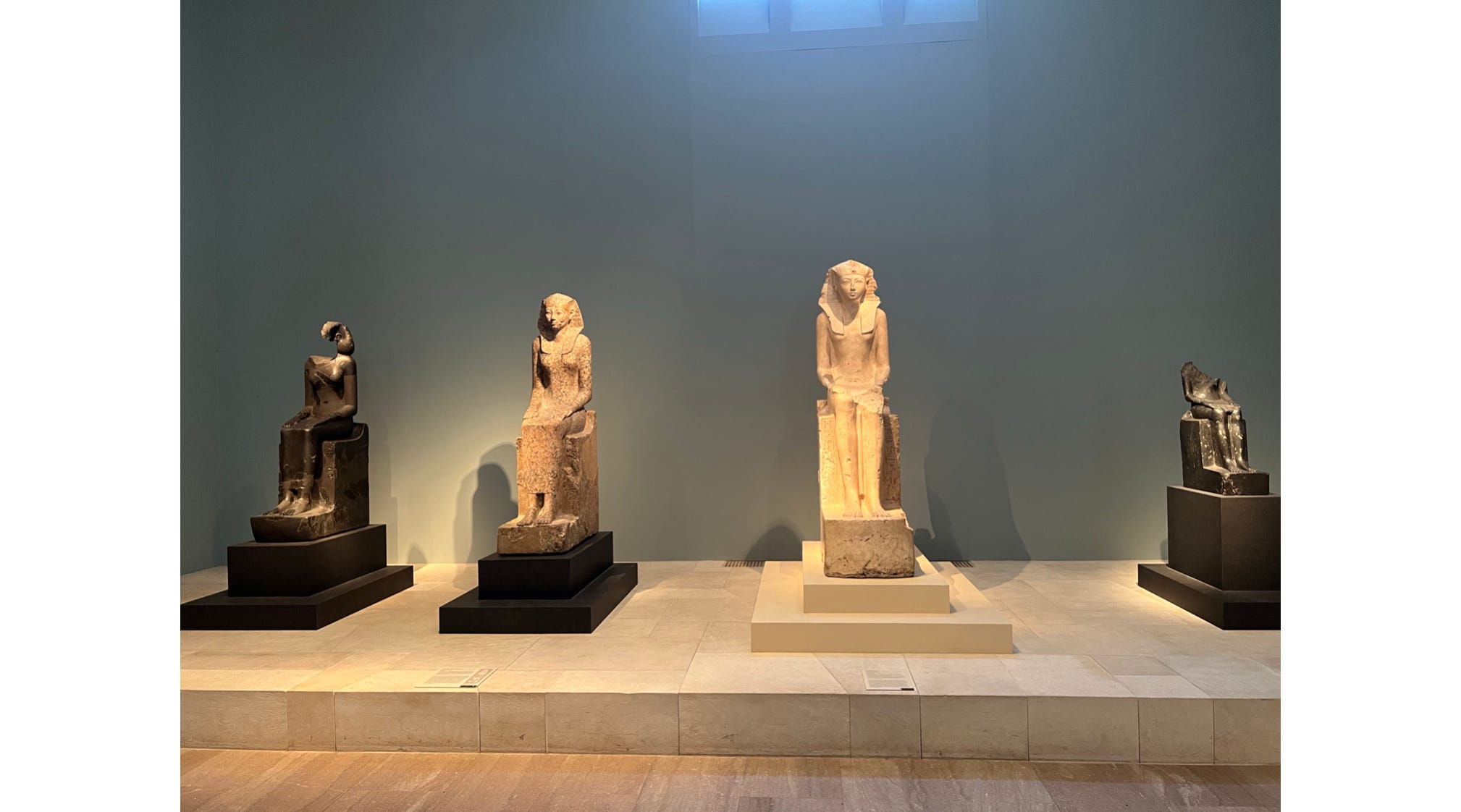
Pharoah Hatshepsut at the Met Museum, photo by me
First published Aug. 26, 2025
Dear Hatshepsut
It’s me again. I know. I don’t shut up. I’m perfecting the practice of the unreliable narrator.
The antonym of unreliable is permanent, durable, stable, predictable, etc. I have a feeling you already know.
When a visitor walks through the Hatshepsut Gallery at the MET Museum, they can see four of your statues next to each other. As they go from left to right, your depicted body goes from femme to masculine; breasts fade, the waist becomes thinner, the King Herself comes forth. It’s not unreliability in the eyes of the beholder. It is unreliability in the body of both object and subject.
The antonym of menopause is permanent, durable, stable, predictable, etc.
As my body has gone from prepubescent, to adolescent, to perimenopause, and now to postmenopause, my body has gone from an almost blank canvas of androgyny bordering on masc before my period started, to femme as my breasts grew in, my waist and hips haggling over curves, until perimenopause kickstarted the thickening of my waist that made it seem as if hips narrowed, with my breasts turning increasingly south, as if to stare downward and marvel at the change, as the King Myself came forth.
Unreliable periods. Unreliable memory. Unreliable woman. Unreliable narrator.
Menopause as the uber Un-.
I want to take what makes a cisgender woman reliable and shake her free. Hatshepsut, you are my inspiration for that.
Reliable for who? You did everything right. You were so reliable that ancient Egypt had a massive growth spurt. Your reign is associated with an infrastructure boom.
And still they erased you.
Reliable for who? Reliable, as the straight line that leads from phallus to patriarchy, with no room for the rest of us? Unreliable for me.
Is an unreliable narrator a liar or just in charge?
Hashepsut, as you made Egypt more powerful by focusing on infrastructure–by building–you were becoming more powerful by restructuring–by unbuilding, by unbecoming, by deliberately wrecking to rebuild–to become the King Herself.
To unbecome I must shake free from reliability. And in the in-between, I become what I want.
So believe nothing I tell you. It’s not so much “alternative facts” as unreliable tales, which I demand the right to tell because patriarchy is a big, fat liar.
So I am disrupting the narrative around you, Hatshepsut–I am claiming my unreliability–to rebuild you.
What if they erased you because you made visible–therefore possible–gender unreliability? What if as it moves from left to right, as your body goes from femme to masculine, as your breasts fade, your waist becomes thinner, and the King Herself comes forth, you demanded to be shaken free from reliability, and in the in-between, to become what she/he/they wanted: gender unreliability.
The same gender unreliability that menopause makes possible in which I am not a woman simply because I bleed once a month–I don’t anymore–or because my womb housed and delivered offspring–it did not–but because what makes me a woman is so much more than that?
Who set the default and destination at Man? What if my gender is unreliable enough to throw out that map and that destination? Thus liberated, must I know where I am going?
What if menopause is the necessary wreckage. Wreckage as necessary and powerful. Wreckage as liberation. Wreckage that transforms, not destroys.
Hashepsut, as you made Egypt more powerful by focusing on infrastructure–by building–you were becoming more powerful by restructuring–by unbuilding, by unbecoming, by deliberately wrecking to rebuild–to become the King Herself. And twenty years after you died, your nephew and sitting pharaoh did all that he could to erase you–e.g., scratched out your face in temple depictions and other such reminders that patriarchy then, as now, will find ways to wreck you.
So, let us be the authors of our own wreckage.
I look back at the years behind me as if reassessing a wreckage of sorts. A necessary wreckage. I don’t know who I am becoming but to emerge into her, I must unbecome.
We are not taught to unbecome. And we rarely learn to unlearn or that unlearning is wreckage–of patriarchy’s dicta, of that straight line from patriarchy to phallus as the default, with no room for the rest of us.
What if menopause is the necessary wreckage. Wreckage as necessary and powerful. Wreckage as liberation. Wreckage that transforms, not destroys.
Wreckage to let the Mona I became go, several times over, as if beginning anew on a fresh canvas, as you did, Hatshepsut with each new statue going from left to right.
What if the wreck that you knew the patriarchy would make of your legacy—or at least try—was the wreck that I welcome so that I can unbecome who I was, to become who I must be?
Hatshepsut, did you ever think: I’ve forgotten who I was, and I don’t know who I’m becoming?
Was it when you realized—truly and viscerally for the first time—that you too were going to die—as we all are?
Did they smash and erase depictions of you because your very existence—that demanded we ask those questions, that liberated us to ask those questions, that made you the King Herself—was too dangerous?
What if history is indeed written by the winners and I am the winner of my story?
What if the wreck that you knew the patriarchy would make of your legacy—or at least try—was the wreck that I welcome so that I can unbecome who I was, to become who I must be?
What if menopause is hard because it is the process by which we are liberated from the destiny we were told our biology was? Through a form of wreckage.
Wreckage as liberation, as transformation, not as damage, not as destruction.
Hatshepsut, I hate that Cleopatra is who they think of when they think of women who ruled Egypt and rarely you. You symbolise growth for ancient Egypt. She came at the end as Rome rose and Egypt declined. I hate that her relationships with Marc Anthony and Julius Caesar define her reign as Elizabeth Taylor defines what people today think she Cleopatra looked like.
I hate that she is defined by melodrama and you are defined by erasure.
That’s why I’m an unreliable narrator, Hatshepsut. Because I demand to be the winner of my own history, and to do that I refuse the map that patriarchy–or, allow me some cliche:“HIStory”--demands I follow.
Unreliable woman. Unreliable memory.
The narrator of his/her/their story.
The narrator of your story.
The narrator of my story.
Thank you for reading my essay. You can support my work by:
Hitting the heart button so that others can be intrigued and read
Upgrading to a paid subscription to support FEMINIST GIANT
You can also support my work via Patreon
Mona Eltahawy is a feminist author, commentator and disruptor of patriarchy. Her new book, an anthology on menopause called Bloody Hell!: Adventures in Menopause from Around the World, has just been published. Her first book Headscarves and Hymens: Why the Middle East Needs a Sexual Revolution (2015) targeted patriarchy in the Middle East and North Africa and her second The Seven Necessary Sins For Women and Girls (2019) took her disruption worldwide. It is now available in Ireland and the UK. Her commentary has appeared in media around the world and she makes video essays and writes a newsletter as FEMINIST GIANT.
I appreciate your support. If you like this piece and you want to further support my writing, you can like/comment below, forward this article to others, or send a gift subscription to someone else today.
Can't wait to read it!