
Fucking Fabulous #2: Creating New Maps
Letters of Love and Farewell to My Fifties

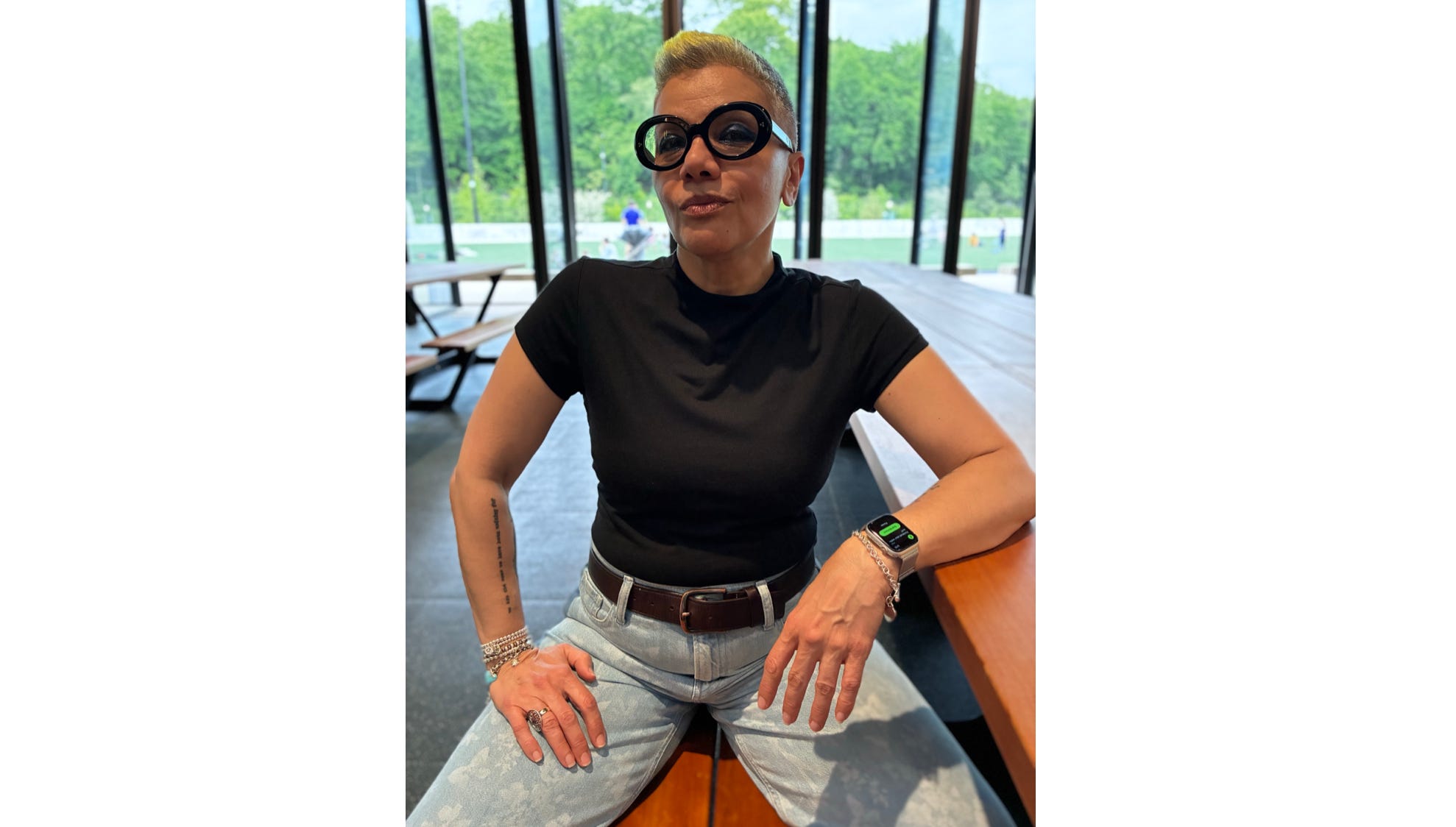
Photo: Robert E. Rutledge
read: Fucking Fabulous #1: Off Kilter
I lost the ability to lie to myself in my fifties. I do not wish it on anyone. But it’s fucking fabulous.
I do not wish it on anyone, this dare to yourself to tell the truth, to your own face. To say “Perhaps that version of my story served me when I was younger, perhaps because I did not have the fortitude to say ‘stop lying’ to my face.”
Each of us has a personal soundtrack on autoplay in our head: That constant, inner monologue that is quite often the stuff of myths and lies, unlike affirmations that we are encouraged to say out loud to boost us into action or over a dip in self confidence.
Often on a loop, with no option to pause or erase and rewind (for those old enough to know what that means because they’ve held cassette tapes in their hands), it is easy to believe it’s the truth because it’s so constant.
I give a fuck. I want the truth.
One’s personal lore, or mythology of the self, can be as stubborn as a scar. Even when its sharpness wanes, the wound remains; the scar an echo, persistent.
Perhaps that’s what some call no longer giving a fuck. But we do; we do.
I give a fuck. I want the truth.
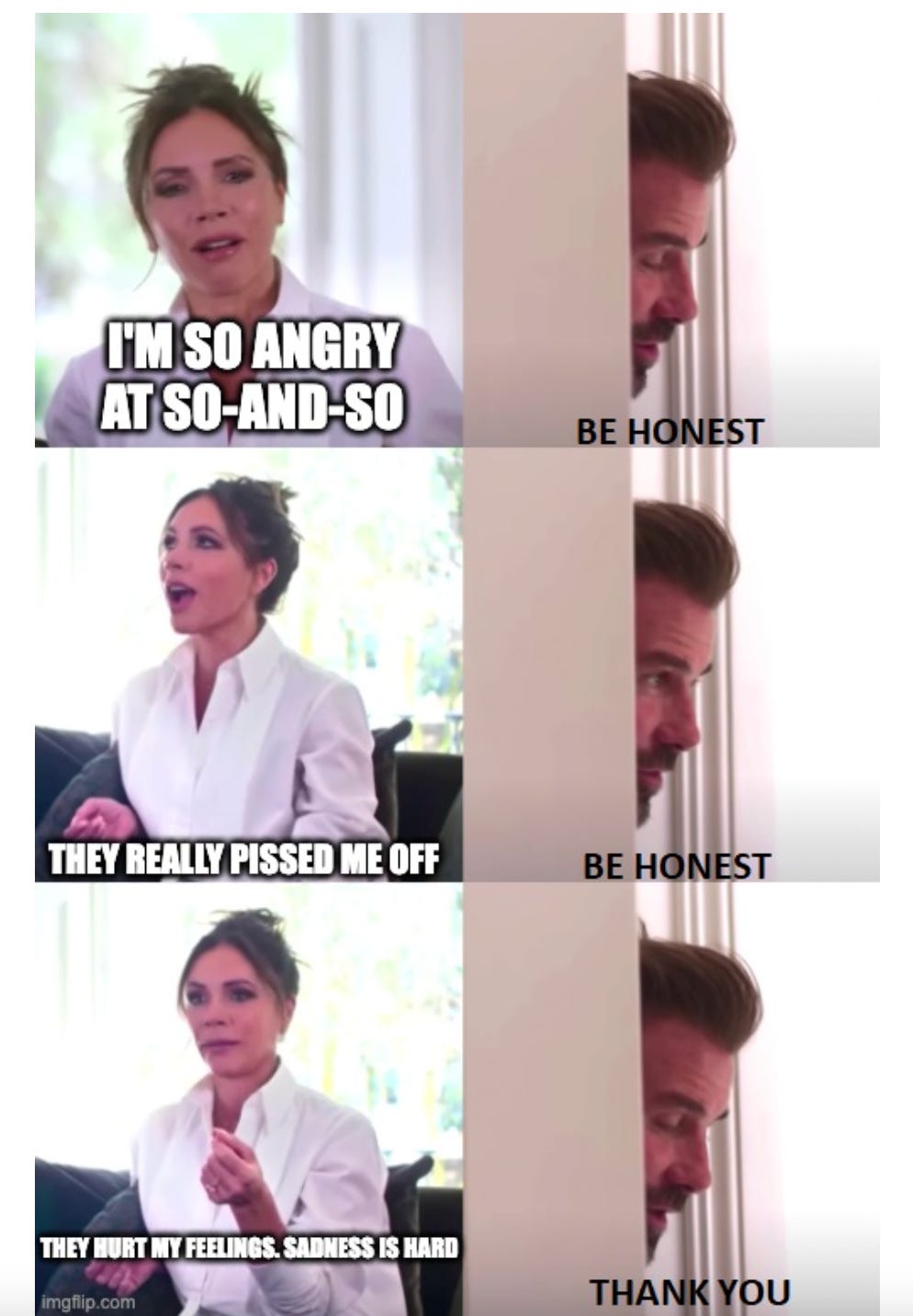
And since I lost the ability to lie to myself in my fucking fabulous fifties, my personal myths have been falling fast and furiously. It’s like the memes that circulated after the David Beckham documentary showing him entering the room where his wife Victoria is misrepresenting her family’s wealth when she was growing up. David keeps exiting and re-entering the room, interrupting Victoria’s half truths until she finally says the truth: that she grew up rich.
Sometimes, I play David to my Victoria during that softest and most vulnerable time: my morning face cleansing ritual. Sleep delivers me unto consciousness once again, and those early minutes in front of the mirror, soothing and swiping balms and oils onto my skin, are often when I am most aware of that soundtrack of solipsism. Off I swipe the previous night’s retinol, and in enters my David to interrupt my Victoria’s half truths.
You don’t need to know all my David and Victoria back and forths. They’ve been useful to my dare to stop lying to myself. But I will share this one with you because it surprised even me
I tried to blow up a professional relationship very soon after the episode of vertigo that I describe in Fucking Fabulous #1. I was adamant in my anger. It was a steadying force in the face of the spinning room triggered by vertigo. Anger as my emotional blanket. I know it. We’ve been friends since I was a girl. It helps me get things done. And quickly. I have no patience. Now, now, now. And so I blew up the relationship. Or at least tried to.
It wasn’t anger that I felt, though. I was sad. I was hurt. When I was younger, I would not have slowed down enough to bring sadness back from the outer regions of my being where I had banished it.
The more my David pushed my Victoria, I felt like I was living my own version of Inside Out, one of my favourite films. In the animated film, 11-year-old Riley is learning to navigate emotions. Joy, Sadness, Anger, Fear, and Disgust are shown as distinct characters running Riley’s life from a command centre. I shared in common with the film a determination to banish sadness.
In the film, that banishment is instigated by Joy who thinks she knows best and that Sadness was unnecessary. In my film, Anger kicked sadness into exile. I knew that Sadness and Patience were the currency too often offered to girls and young women as buoys in the violent waters of patriarchy.
Once upon a time I was a volcano who believed she was a girl. Or was I a girl who knew her eruptions were a thing of beauty, a force not to be trifled with? I erupted in rage and impatience, many times in the ways that Ursula K. Le Guin encouraged before I knew who Ursula K. Le Guin was. And I honour those eruptions!
My mother has been an essential role model as a woman who easily accesses her anger and uses it to change things and for that I am forever grateful. She has shown me that a woman can be angry and can indeed be fucking enraged and I have learned.
I’m changing the map of Mona. That kind of change demands patience. Anger was always easier for me to navigate than sadness. Anger is frenetic and about now-now-now. Who had the patience to sit still for sadness?
Menopause didn’t gift me rage. I’ve always had that, aplenty. The power that came with menopause for me meant that I could now access sadness as a strength; to stand in the power of that emotion that can so easily incapacitate girls (that’s what patriarchy counts on) but which, as a woman in my fifties, I’m wielding to clarify and clear the debris of half truths that stand in my way as I mature into the woman I am still becoming.
Sadness is the internal eruption to anger’s external ones. My eruptions are now changing my internal landscape.
“We are volcanoes. When we women offer our experience as our truth, as human truth, all the maps change. There are new mountains,” Le Guin told the 1986 graduating class at Bryn Mawr.
I’m changing the map of Mona. That kind of change demands patience. Anger was always easier for me to navigate than sadness. Anger is frenetic and about now-now-now. Who had the patience to sit still for sadness?
But I am the cartographer of my being and those new mountains need stillness. And time.
And it is fucking fabulous.
Thank you for reading my essay. You can support my work by:
Hitting the heart button so that others can be intrigued and read
Upgrading to a paid subscription to support FEMINIST GIANT
Opting for a one-time payment via buying me a coffee
Sharing this post by email or on social media
.
Mona Eltahawy is a feminist author, commentator and disruptor of patriarchy. Her latest book is an anthology on menopause she edited called Bloody Hell!: Adventures in Menopause from Around the World. Her first book Headscarves and Hymens: Why the Middle East Needs a Sexual Revolution (2015) targeted patriarchy in the Middle East and North Africa and her second The Seven Necessary Sins For Women and Girls (2019) took her disruption worldwide. It is now available in Ireland and the UK. Her commentary has appeared in media around the world and she makes video essays and writes a newsletter as FEMINIST GIANT.
I appreciate your support. If you like this piece and you want to further support my writing, you can like/comment below, forward this article to others, or send a gift subscription to someone else today.
I really loved your concept of creating a new "map" of the self - it will stay with me for a while!
wow this was incredibly powerful, and really beautifully written. The vulnerability softens us all
"One’s personal lore, or mythology of the self, can be as stubborn as a scar."